

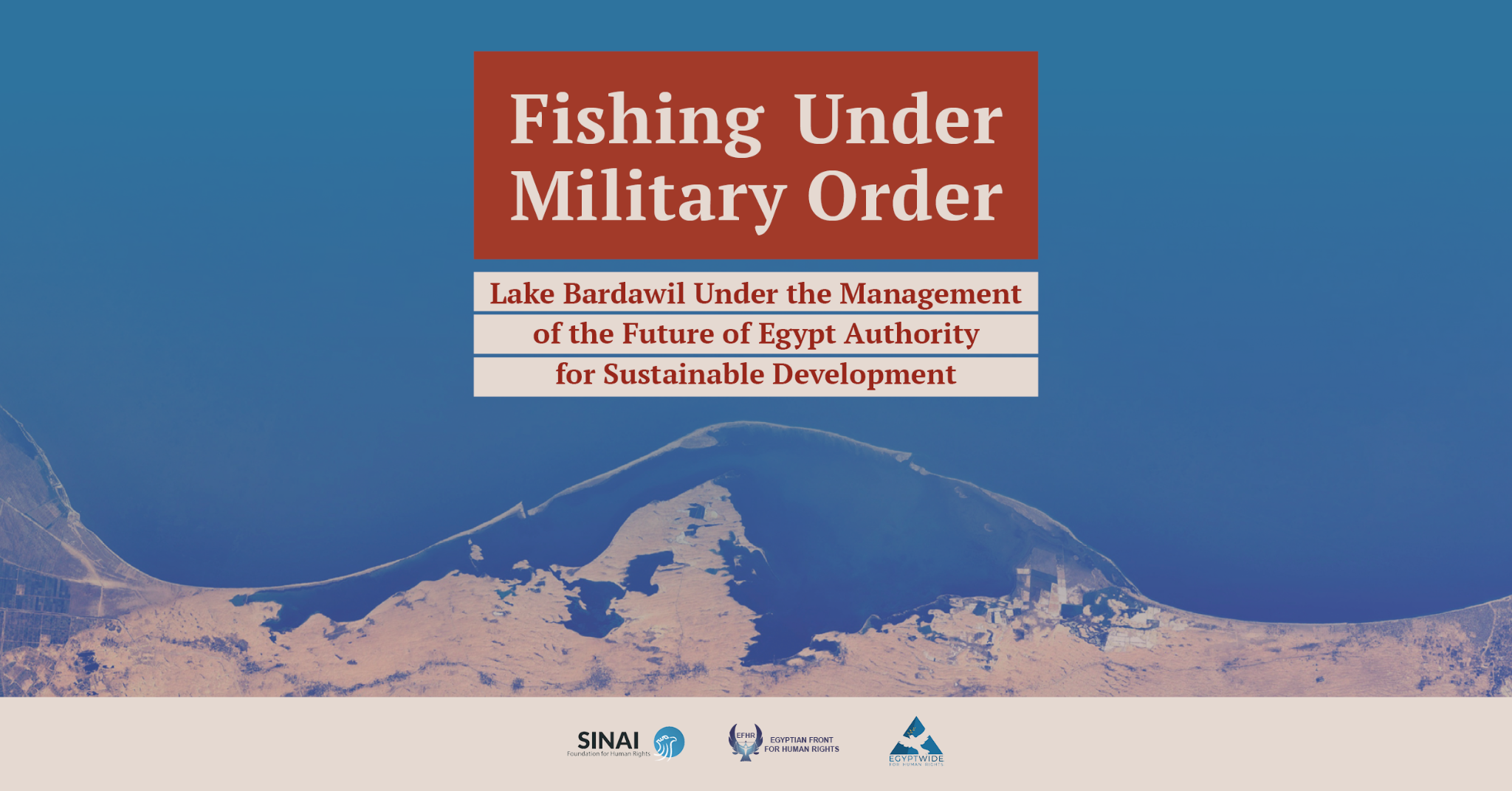
NEW REPORT - Fishing Under Military Order: Lake Bardawil under the Management of the Future of Egypt Authority
Today, the 28th July 2026, EgyptWide for Human Rights, Sinai Foundation for Human Rights (SFHR), and the Egyptian Front for Human Rights (EFHR) announce the publication of their joint report titled "Fishing Under Military Order: Lake Bardawil under the Management of the Future of Egypt Authority."
The report documents the deterioration of social and economic rights among local fishing communities of the Lake Bardawil area, in Egypt’s Sinai Peninsula, under the administration of a military-affiliated entity appointed by President Sisi in 2024 to oversee and regulate fishing and related activities in Lake Bardawil. Ironically called “Future of Egypt Authority for Sustainable Development”, the agency has already acquired a vast amount of agricultural lands alongside infrastructure and production plants across Egypt, extending its control to the related production and supply chains through a state-sponsored regime of monopoly which exemplifies the Egyptian military establishment’s predatory activism in the national economy. Lakes such as Bardawil, considered to be one of Egypt’s largest natural lakes, are among the natural resources which were recently placed under military administration and jurisdiction through Presidential or Cabinet decrees citing their strategic value.
Our report has documented an alarming pattern of water grabbing, shielded by the military’s ability to leverage administrative prerogatives and financial privileges under a set of policies consolidating their control over the national economy, which is depriving local indigenous communities of access to the lake waters, representing for many of their primary or sole source of sustenance, as communities rely on fishing as a traditional economic activity.
The report has found that, under the Future of Egypt Authority for Sustainable Development, fishing is regulated through a set of unreasonably restrictive provisions, making the renewal of fishing licenses remarkably burdensome and increasing its cost more than twentyfold (from 30-50 Egyptian pounds to about 1,800 per fishing season), and sanctioning fishers for administrative breaches through the imposition of heavy fines or charging in military trials, which runs counter to the principle of proportionality and the right of civilians to be tried before a competent civilian, not military, court.
We also documented how, in its dual role of regulator and market actor, the Future of Egypt Authority for Sustainable Development has engineered a system to extract the highest possible value from the fish value chain at Lake Bardawil by imposing retail prices and suppliers for all fishing-related products, including boat fuel and drinking water, and forcing fishers to sell their daily catches below market prices to the Authority’s traders, who then resell them above market value, profiting from the difference while eroding the revenues of civilian fishers and traders.
We found that between 2025 and the first semester of 2026, at least 13 fishers from the Lake Bardawil area were arbitrarily arrested on charges of “fishing without a valid permit” or “trespassing into a border-adjacent zone”- which designates the entirety of the lake and its surroundings under Presidential Decree No.114/2024-, and successively detained for prolonged periods in overcrowded detention facilities before being tried before a military court in Ismailia, in trials which their lawyers and Amnesty International described as marred with violations.
We conclude that the Future of Egypt Authority for Sustainable Development’s management of Lake Bardawil is the primary cause for growing poverty and food insecurity among local communities, whose consequences include the dismantling of the social fabric with the migration of a rising number of individuals towards other governorates inside the country or to Europe via the Mediterranean sea, families’ resort to child labor, and mounting debt among workers and civilian businesses unable to cope with the erosion of their revenues.
The report triangulates 28 field interviews, previous research studies in the economic and environmental conditions of the area, and policy analysis of domestic and international frameworks relevant to the rights of Indigenous peoples, Egyptian constitutional and legal texts, and relevant administrative decisions shaping the Future of Egypt Authority for Sustainable Development’s unaccountable and unsustainable management of Lake Bardawil and the local fishing industry.
The report is complemented by a set of recommendations to Egyptian decision makers reflecting our findings and incorporating demands expressed by local communities in interviews, specifically: restoring civilian oversight and administration of Lake Bardawil, and ending the Future of Egypt Authority’s monopoly over the local market; ending the referral of fishers to military prosecution, release those currently detained, and suspend the sentences of those subjected to unfair trials in military courts; conduct independent environmental and social impact assessments prior to any development interventions, and involve local communities in decisions concerning the lake's future through dedicated and effective consultation mechanisms; and support independent fishermen’s cooperative associations of the Lake Bardawil area, so that they can regain their historic role of representing and serving the lake's fishing communities.
The report is available in Arabic and English. The Authors remain available for further information or comments.
Recent Posts
Most viewed

Related Postes
 English content
 English content